THE GIVING OCEAN
An Ongoing Art Exhibition
There is a book many of us were read as children. It is about a tree that gives - shade, apples, branches, trunk - and asks for nothing in return. Most of us remember how that story made us feel. This exhibition borrows that spirit and carries it to the water’s edge. The ocean, like that tree, has always given.
The question this show asks - gently, honestly, and with great hope is - what will we give back?
The Giving Ocean is more than an exhibition. It is an invitation - to wonder, to grieve, to connect, and ultimately, to act. Five chapters. One story.
Carolina Nakiri
StorytellART Curator
CHAPTER 1: THE SOURCE
Every second breath we take was made possible by the ocean.
Microscopic marine phytoplankton produce roughly half of all the oxygen on Earth. The ocean regulates our climate, absorbs our heat, feeds billions of people, and drives the water cycle that fills every river, reservoir, and raindrop on the planet.
The works in this chapter ask viewers to sit with something quietly staggering: the ocean is not a place we visit on holiday. It is the living foundation beneath everything — our air, our food, our weather, our survival. These pieces carry scale and wonder. They are an invitation to look at the sea and truly see it as the source of life itself.
This is where the story of the ocean begins.
Terrill Welch
Winter Song of the Salish Sea
Walnut oil on canvas 36” x 40”
CAD 11,920
There are only a few days in a year when the sea is midnight blue and sun catches the ocean spray. They tend to be after heavy rains and high winds during the winter when the sun hangs low and makes but a brief appearance.
During these times the sea and air snaps with energy and I am fully prepared to get wet to capture my references and clean the saltwater off of my lens when I get home. Then I will revisit these moments several times with a canvas on the easel, like in this painting. - T. Welch
Agathe Bernard
Where I Came to Watch the Moon Rise
Fine Art Photograph Print 24” x 36”
CAD 650 (framed)
This photograph was taken on the rocky shore of Ucluelet, where the Pacific arrives with its full force, crashing in turquoise, white, and thunder against the edge of land.
I used to come to these rocks often, specifically to watch the moon rise. I would sit there as the day softened, waiting for that powerful moment when the moon lifted above the wild water and everything inside me seemed to settle.
The ocean was never gentle here, but that was part of its medicine. Its power cleared what felt heavy. Its salt air moved through me. Its rhythm reminded me that I did not have to hold everything alone.
There is something about watching the moon rise over a restless sea that makes you feel both small and restored. It's cleansing, humbling and it's a place to remember your own force. -A. Bernard
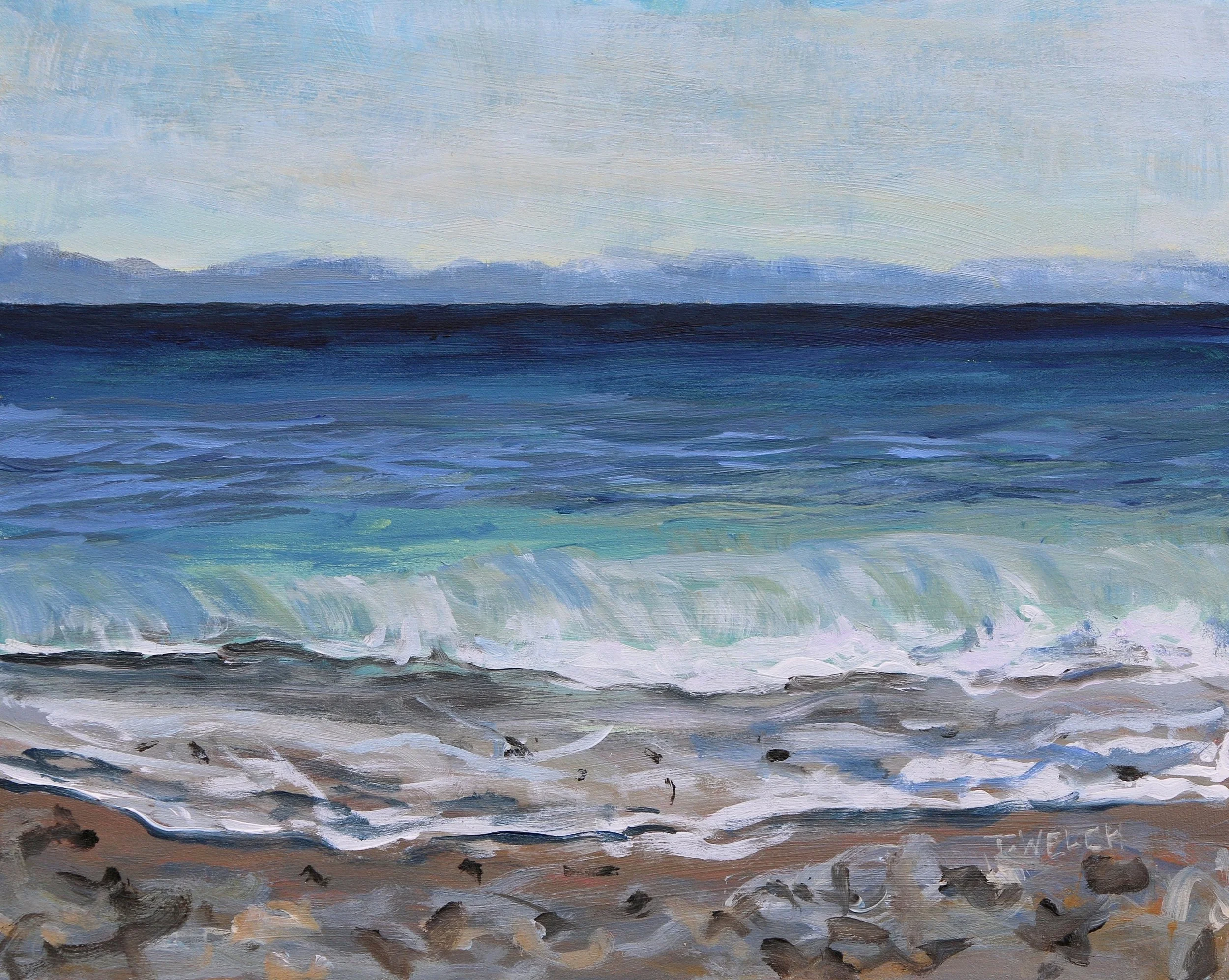
Terrill Welch
French Beach in Mid March Sunshine
Oil on canvas 8” x 10”
CAD 760
I had been up early to catch the ferry from Mayne Island to Swartz Bay and then driving along the southwest coast of Vancouver Island until I reach French Beach. It was just noon and the sun and wind dried the acrylic paint as fast as it came off my brush. Still, it was a great hour to briskly whisk a seascape onto the gesso board. - T. Welch
CHAPTER 2: THE RESIDENTS
Long before the first human drew breath, the ocean was already full of stories.
Orcas navigating vast migration routes with their families, passing knowledge down through generations. Octopuses solving problems, dreaming, shifting colour with thought and feeling. Sharks — ancient beyond imagination — having outlived four mass extinctions. Fish moving in formations so precise and fluid they seem to think as one.
The ocean is not merely water surrounding islands. It is a world — intricate, social, intelligent, and alive in ways we are only beginning to understand.
This chapter introduces the residents: the beings for whom the ocean is not a resource or a retreat, but simply home. They are our neighbours — and all of them can be found in the waters around Vancouver Island.

Sherry Robb
Return to the Sea
Clay, acrylic and resin on board 40” x 40”
CAD 3,900
A walk along Whiffin Spit each spring offers a glimpse into the hidden world beneath the shore. Nature exhales a receding tide, revealing bountiful pools teeming with life and colour as far as the eye can see - a quiet symphony of abundance. But walk gently; these gifts are fleeting and fragile.
Can you name all the sea life and plant species hidden within the composition? Can you see your reflection in her pool? And can you discover the one real object concealed among the handcrafted details?
This piece was crafted entirely from clay, acrylic paint, and finished with resin for strength - preserving a tiny coastal world suspended in a moment of time. Every element was carefully created to reflect the rich flora and fauna of our shoreline. -S. Robb
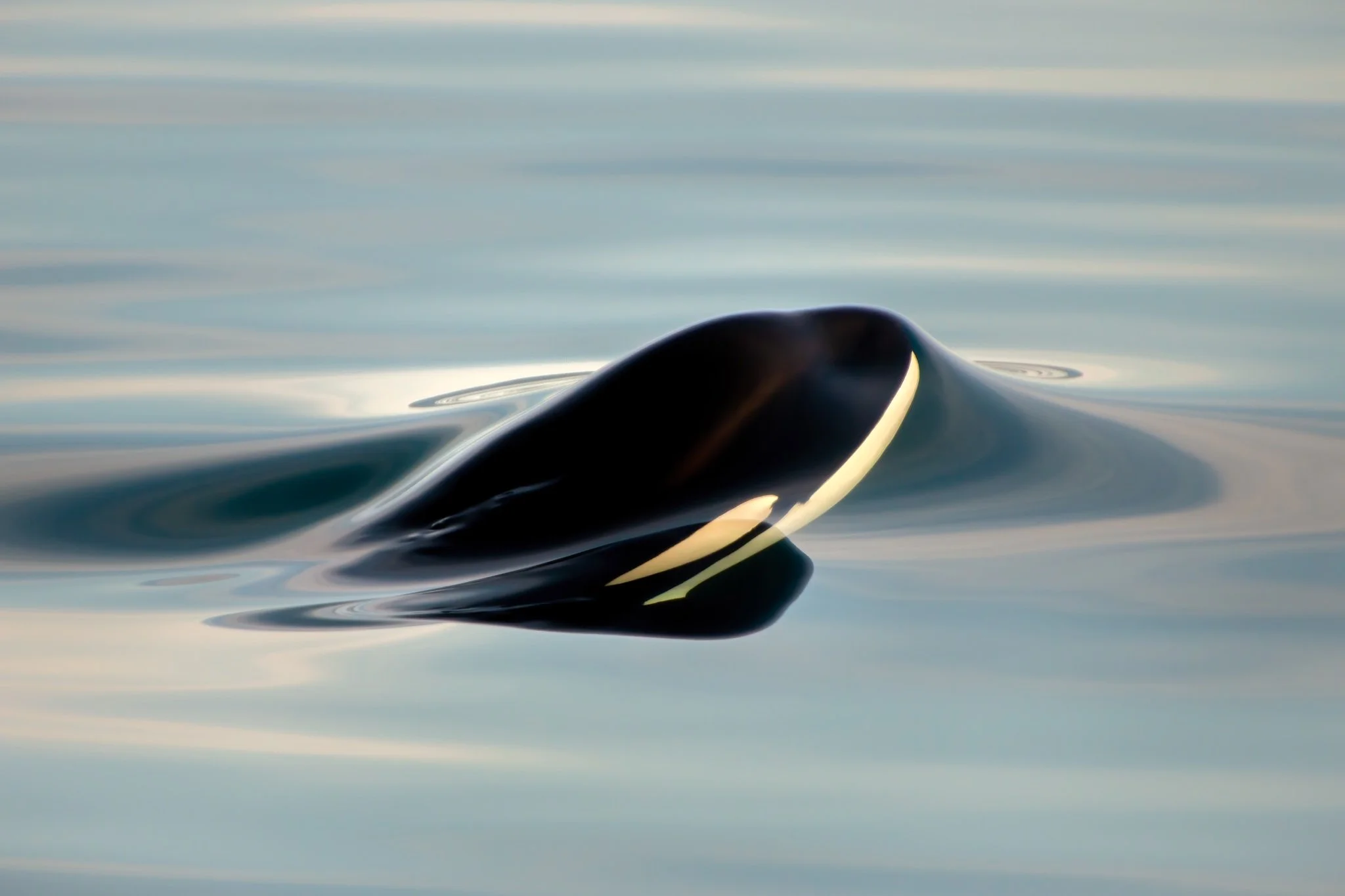
Mark Williams
Surface Tension
Fine Art Photograph Print 24” x 36”
CAD 650 (framed)
SOLD
I’ll never forget this day. I was out canoeing and spotted some orcas in the distance. They were moving faster than I could paddle so I just enjoyed them from afar, then for a reason unbeknownst to me they turned back, breaking our wrongly anthropomorphised assumption of their linear movement.
As they got closer I got my camera out, then they disappeared on a long dive. Their next surface almost made me jump. Their second surface was when I managed to capture this photo, in the split second before the surface tension of the water had been broken and the orca breached the surface. -M. Williams
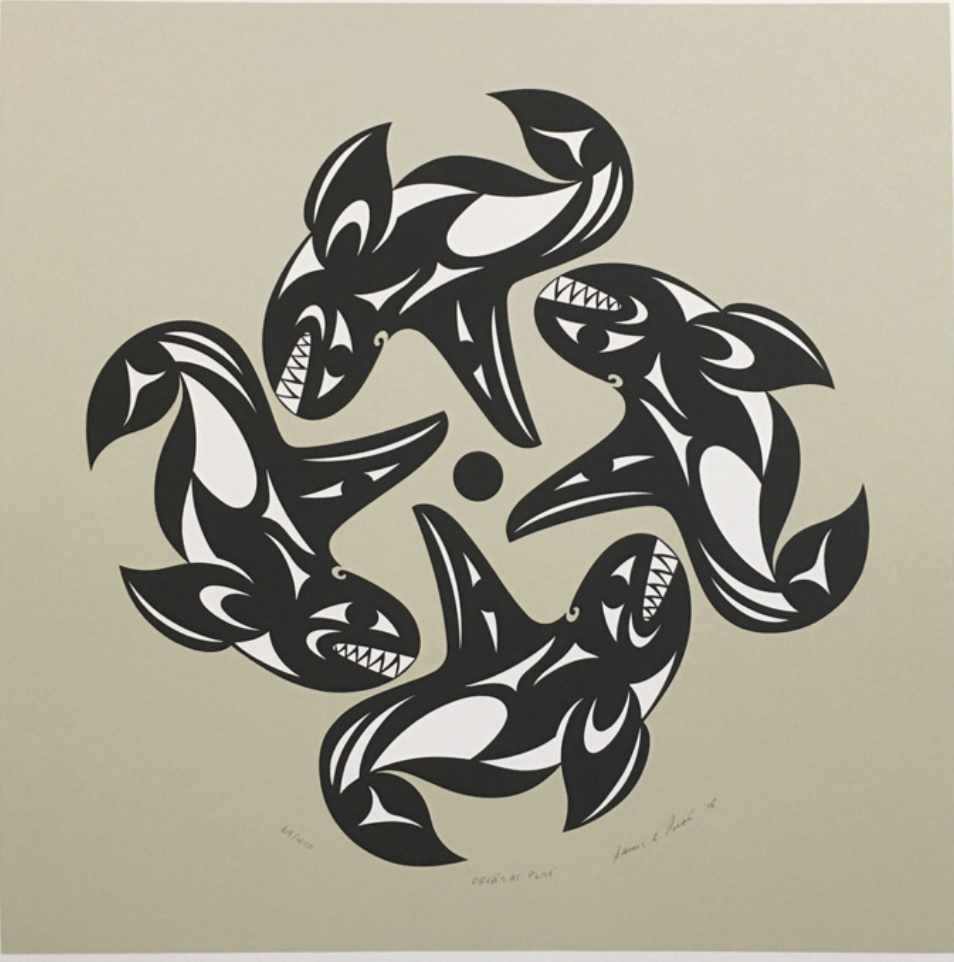
Susan Point
Orcas at Play
Serigraph 21 1/4” x 21 1/4” (framed)
CAD 600 (framed)
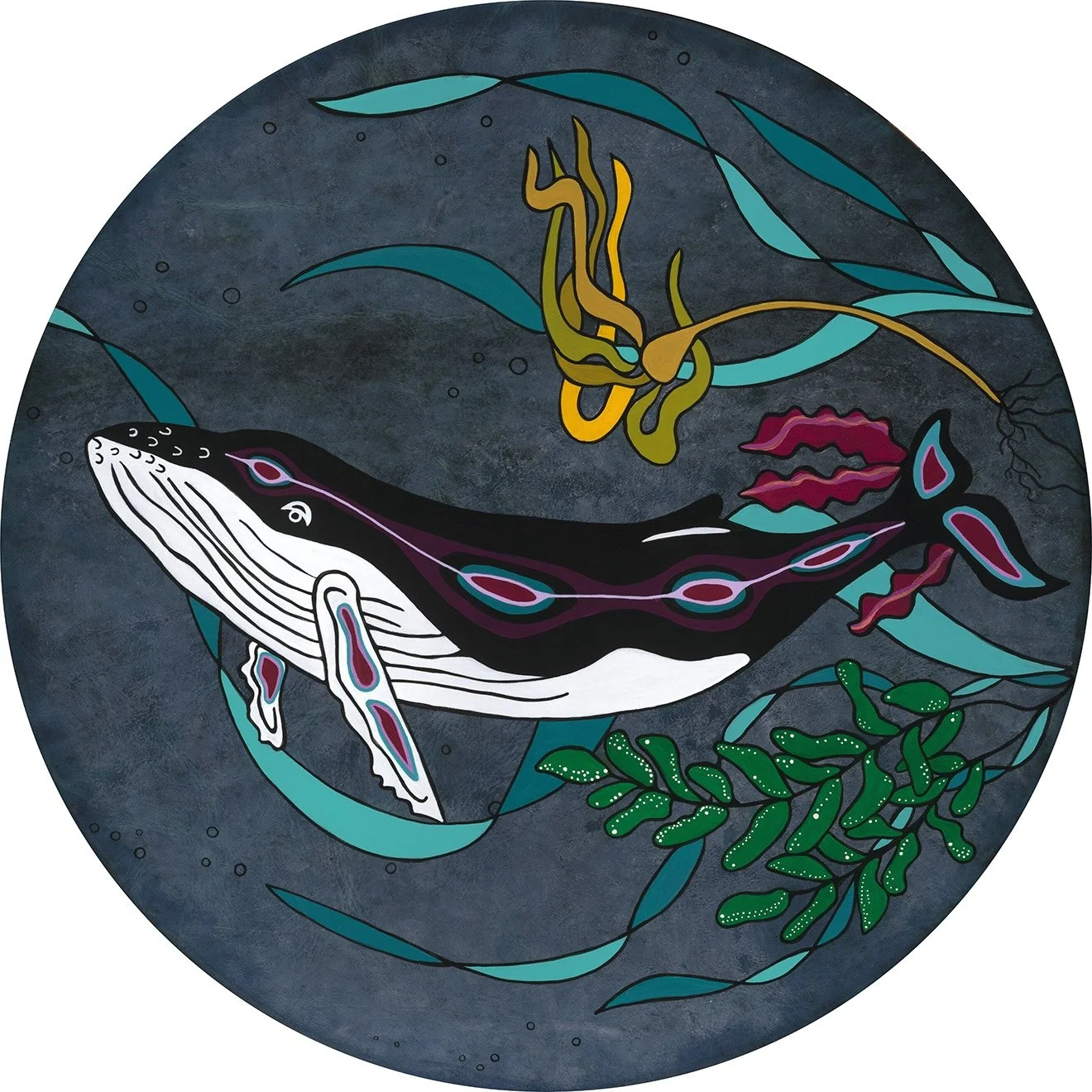
Rhudey - Mi'kmaq from Gespe’gewa’gi,
Elk hide drum, dyed with Indigo, cedar frame, fluid acrylic paint, sinew 28” Diameter
?IIHTUP Teaching Humility
NFS - Prints available for sale
This drum was dyed with indigo using traditional plant dyeing methods during a fish skin tanning workshop at Aunty Collective. When the drum was done I knew it had to be an ocean painting. The whale holds the story of a connection we made with a humpback whale during a visit to Tlahowa - one of the Broken Group Islands and the traditional territory of my sister and elder Jessica Sault.
The whale circled our boat and then breached just far enough away to not capsize us, and let us feel the true joy and beauty of witnessing the power, kindness and this connection brought out an extreme teaching of humility. We wondered if the whale was the same whale from the story that Jessica told us about, the story that is held in The Animal Kingdom song. -Rhudey
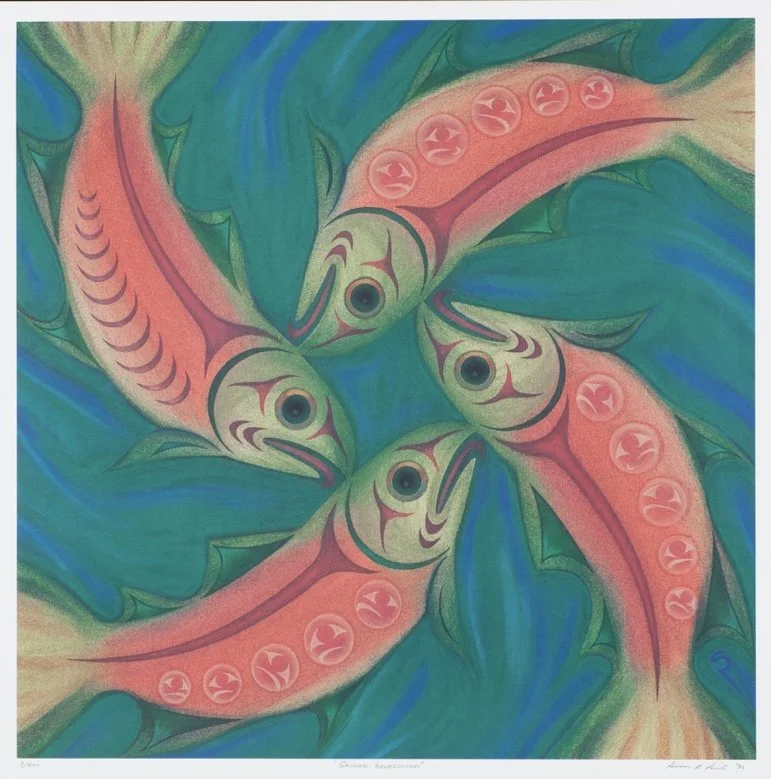
Susan Point
Salmon Homecoming
Off-set Lithograph 26 1/4” x 26 1/4” (framed)
CAD 1,200 (framed)
SOLD
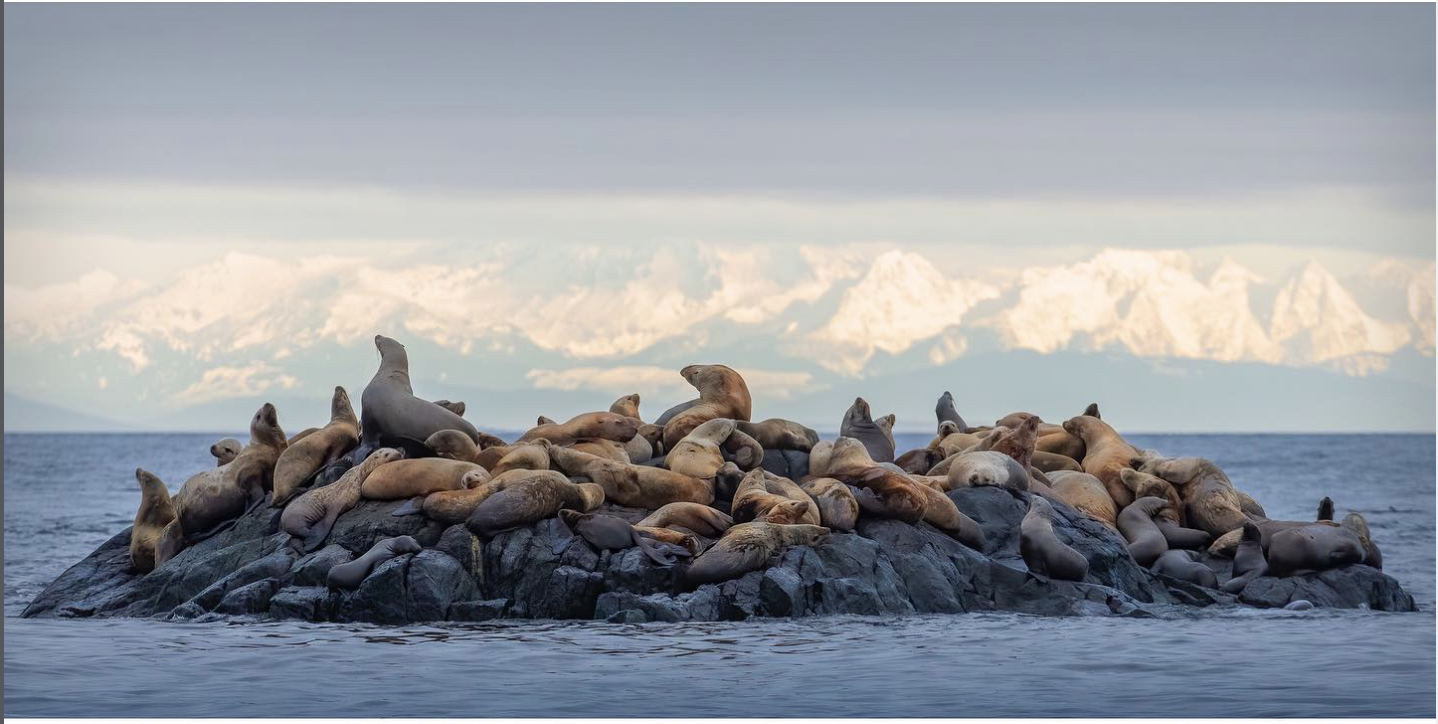
Josh DeLeenheer
Sanctuary
Fine Art Photograph Print 24” x 36”
CAD 650 (framed)
Race Rocks Ecological Reserve is a cluster of small islands in the Juan de Fuca Strait south of Metchosin on Vancouver Island. The reserve offers protection to a variety of species, including Steller and California sea lions, eagles, cormorants, seagulls, and the occasional sea otter.
In an area often heavy with marine traffic, Race Rocks offers a safe environment for wildlife to congregate without risk of human interference. -J. DeLeenheer
CHAPTER 3: THE BLUE GIFT
The ocean gives without ceasing.
Beyond the oxygen we breathe and the food that sustains billions, the ocean underpins a vast blue economy — fisheries, tourism, aquatic sport, transportation, energy. Its contributions to human life are so woven into our existence that we rarely stop to name them.
But some of its gifts are more personal. Bonfires at dusk. Sandcastles with small hands. The particular quality of time spent with people we love at the water's edge. These memories live in us differently — salt-worn, unhurried, luminous.
Researchers now have a name for what coastal communities have always known: blue health. Being near, in, or on water lowers cortisol, quiets the nervous system, and restores perspective. The sound of waves. The horizon line that finally lets the eye rest. These are not luxuries. For many people, they are medicine.
The works in this chapter carry that quality — an invitation to pause, and to remember.
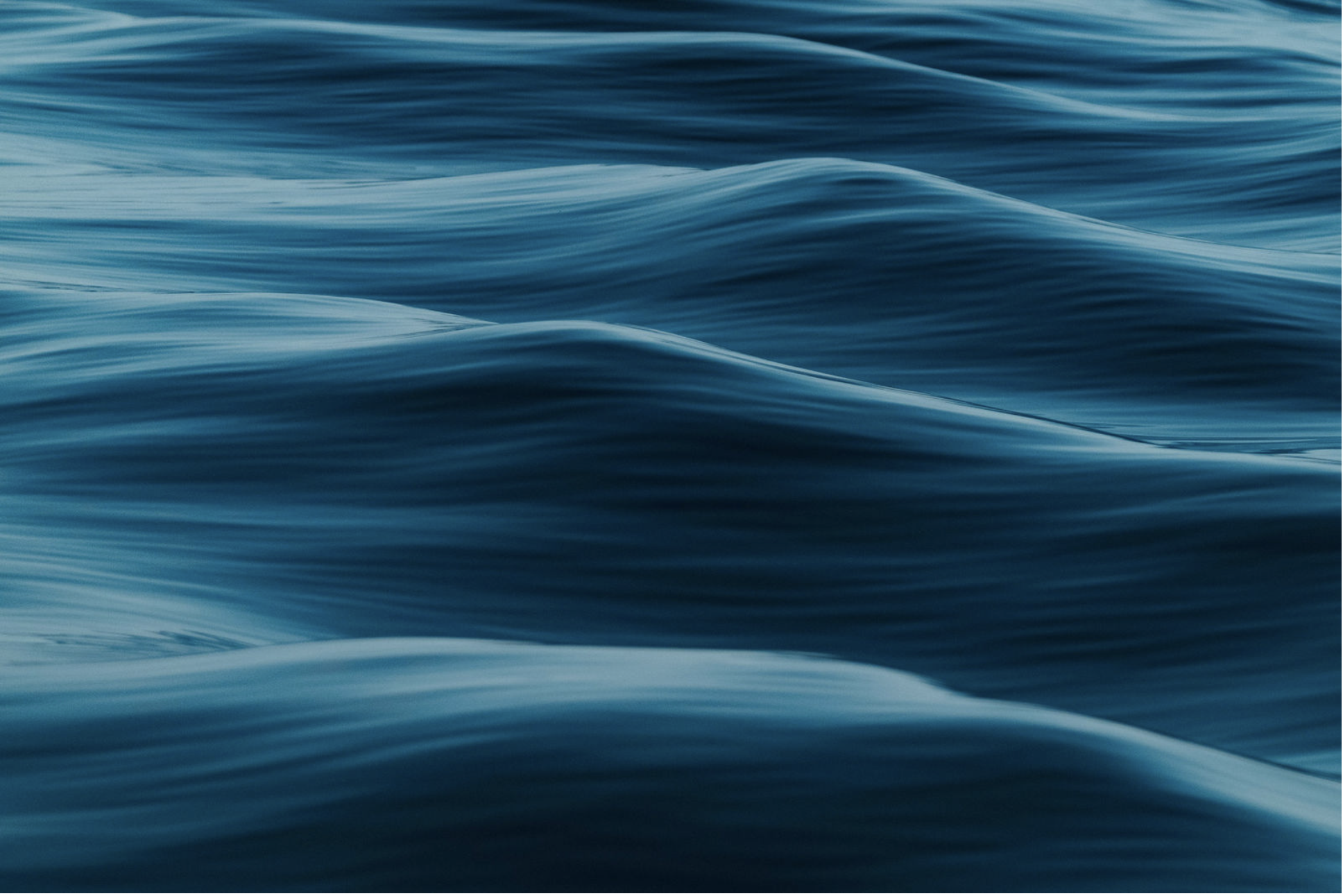
Agathe Bernard
The Wake We Leave Behind
Fine Art Photograph Print 24” x 36”
CAD 650 (Framed)
SOLD
This photograph was taken on my first solo sailing expedition, after four days of 30-knot winds, fear, focus, and learning to trust both my boat and myself.
One morning, I woke in the fog to the sound of whales breathing nearby, unseen, but deeply present. Later, as I returned toward Sointula, the wind softened, the sea opened, and I sat on the bow with the autopilot on, mesmerized by the wake my boat was leaving across a rare, peaceful moment on Queen Charlotte Strait.
This image holds that feeling: the quiet after intensity, the presence of wild lives around us, and the trace we leave behind as we move through the world.
A wave.
A wake.
A reminder that we are never separate from the ocean. -A. Bernard
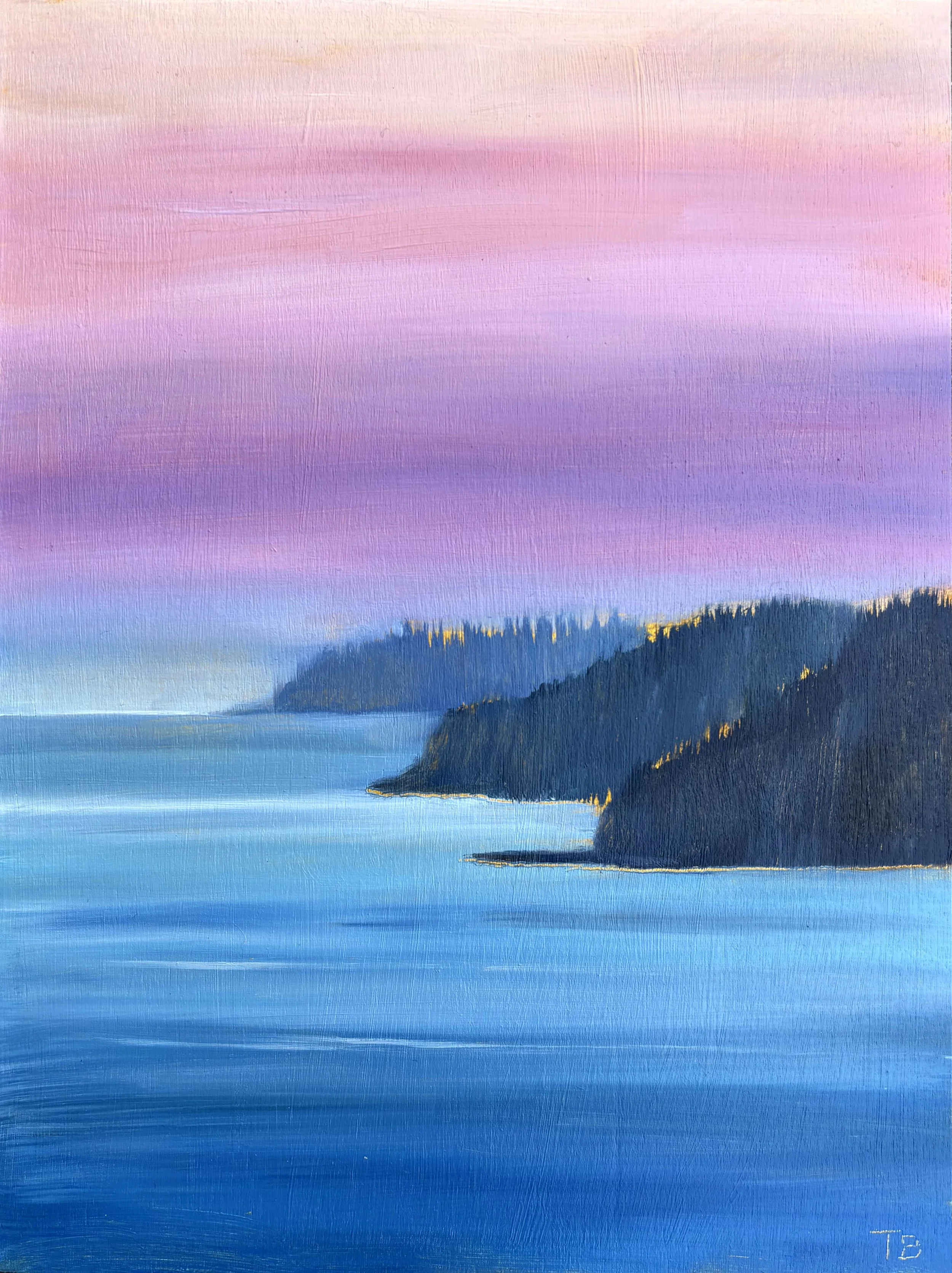
Tiffany Blaise
Coastal Shadows
Oil on panel 8” x 10”
CAD 200
SOLD
This painting grew out of a fascination with the way mist transforms a familiar landscape into something altogether more mysterious. As it lifts, the coastline is revealed slowly, in layers, a family of islands emerging from the haze. Horizontal bands of deep blue water and luminous sky hold the dark silhouette of the forested islands.
The ocean in this piece is quiet and speaks to the kind of stillness that carries weight. It is a reminder that the sea withholds as much as it reveals, and that this quality of mystery is part of what makes it so enduring. -T. Blaise
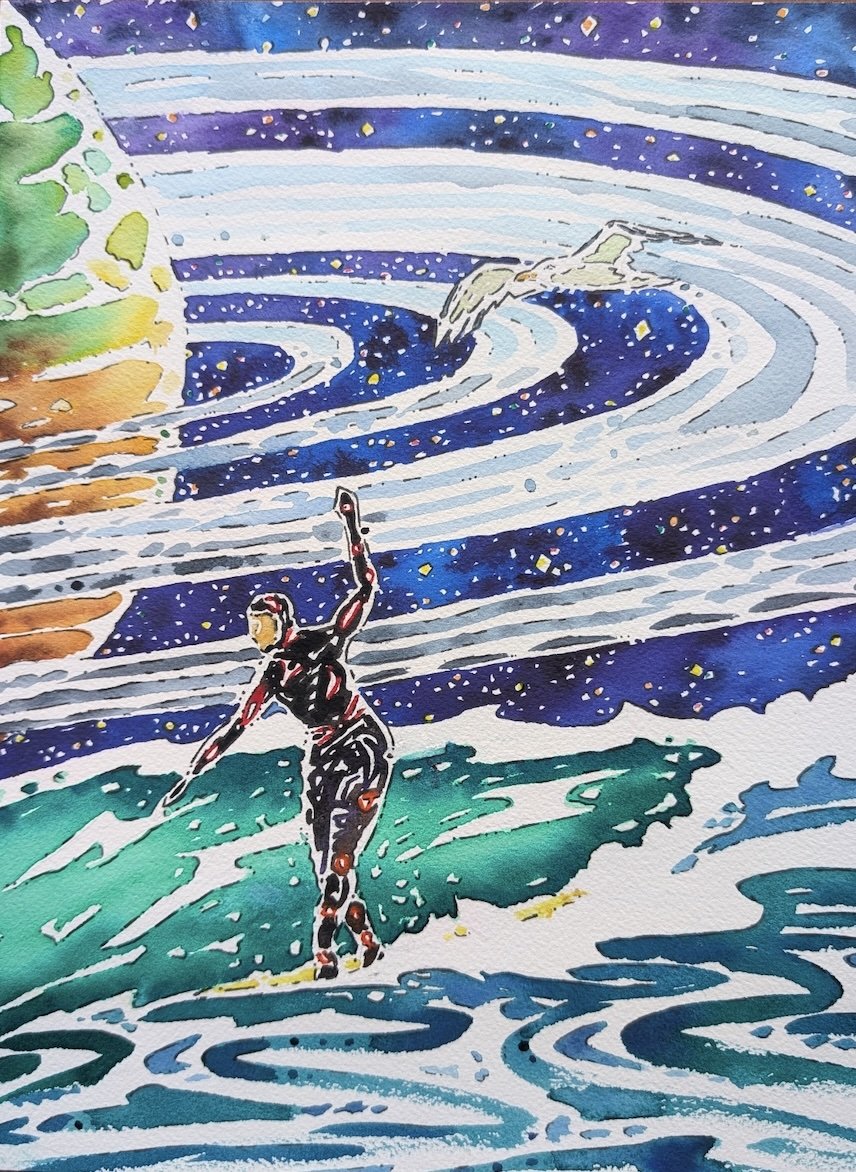
Danny Chico Amato
Gliding Across the Cosmos
Watercolour on paper 9” x 12”
CAD 175
Gazing at the surface of the ocean, I see the night sky reflected on its rolling contours. A wave breaks and the white water is moving with endless stars.
My watercolors begin with a lot of movement across the paper and I see this wandering of pigments and comets after the creation is complete. -D. Chico
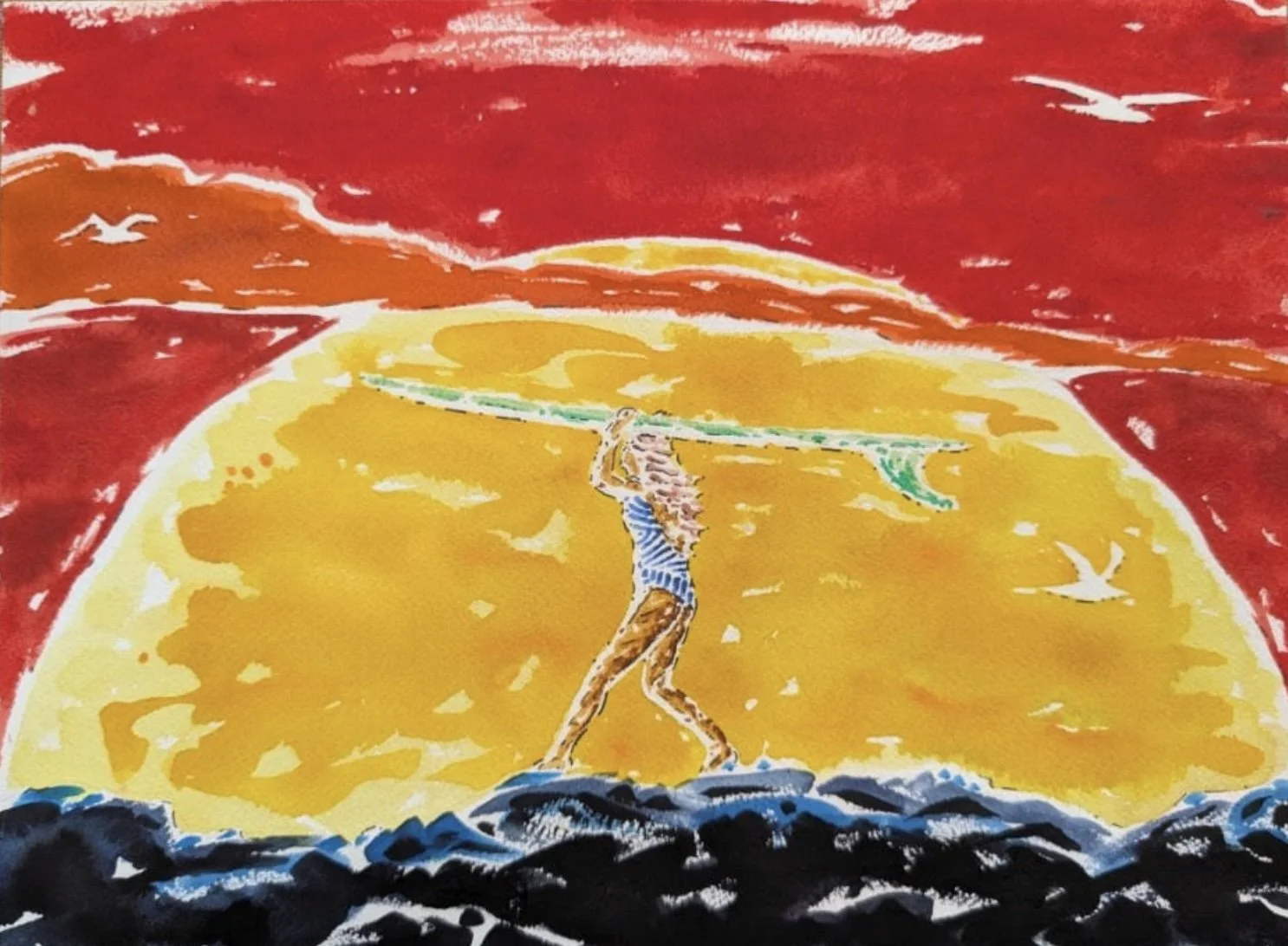
Danny Chico Amato
Radiant Journey
Watercolour on paper 9” x 12”
CAD 175
In Jordan River the Sun is setting on the Sea and distances are viewed equally. A Surfer travels along the rock wall as my paintbrush journeys across the paper, searching for light and mysterious visions. The Earth is spinning and so will our desire to return to the Ocean as the our Star rises again. -D. Chico
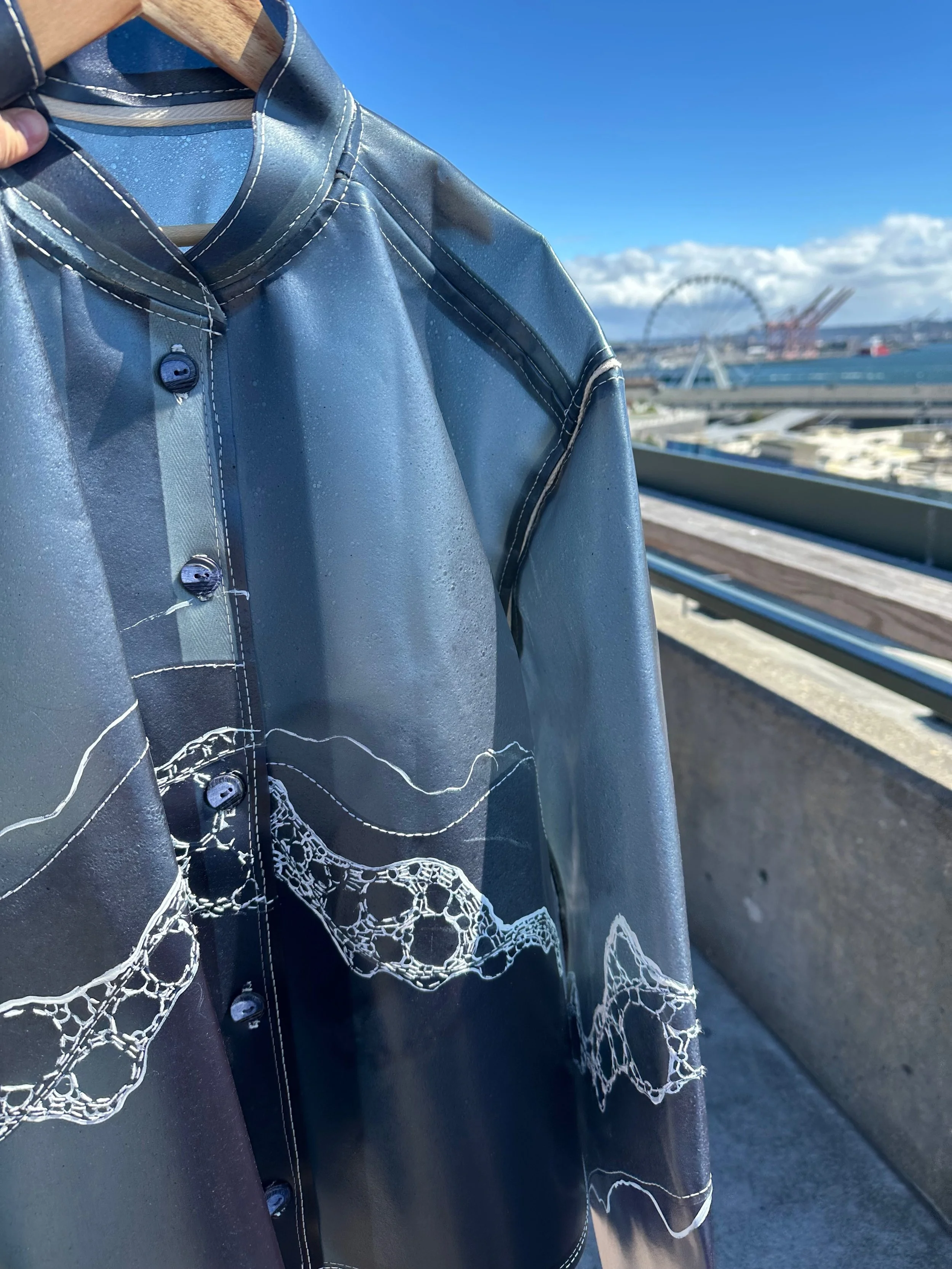
Brenda Palomino
Seafoam
Biopolymer composite, indigo dye, hand embroidery
Inquire to purchase
This jacket begins in the ocean. Sea moss, agar, and kelp were cast into a biopolymer, dried into panels, painted, and embroidered by hand. The colour is indigo. The embroidery is meant to look like seafoam; that thin, fleeting edge the ocean leaves behind.
Making biomaterials means borrowing from a living system. The ocean lends its chemistry so we can create. This piece is an ode to that, and a reminder that gratitude is the least we owe. -B. Palomino
CHAPTER 4: THE TOLL
No honest story about the ocean today can skip this chapter.
The ocean is warming. Coral reefs are bleaching and dying at an accelerating rate. Plastic has entered every level of the marine food chain, from the smallest zooplankton to the largest whale. Oil spills scar ecosystems for decades. Overfishing has pushed many species toward collapse. Bottom trawling devastates seafloor habitats and releases at least as much carbon as the entire aviation industry. The same ocean that gives so unconditionally is being asked to absorb more than it can hold.
And it is reaching its limits.
The works in this chapter do not look away. They bear witness. This is where the exhibition pauses and asks visitors to feel the weight of what is at stake — not to be crushed by it, but to let it matter.
Because the story does not end here.
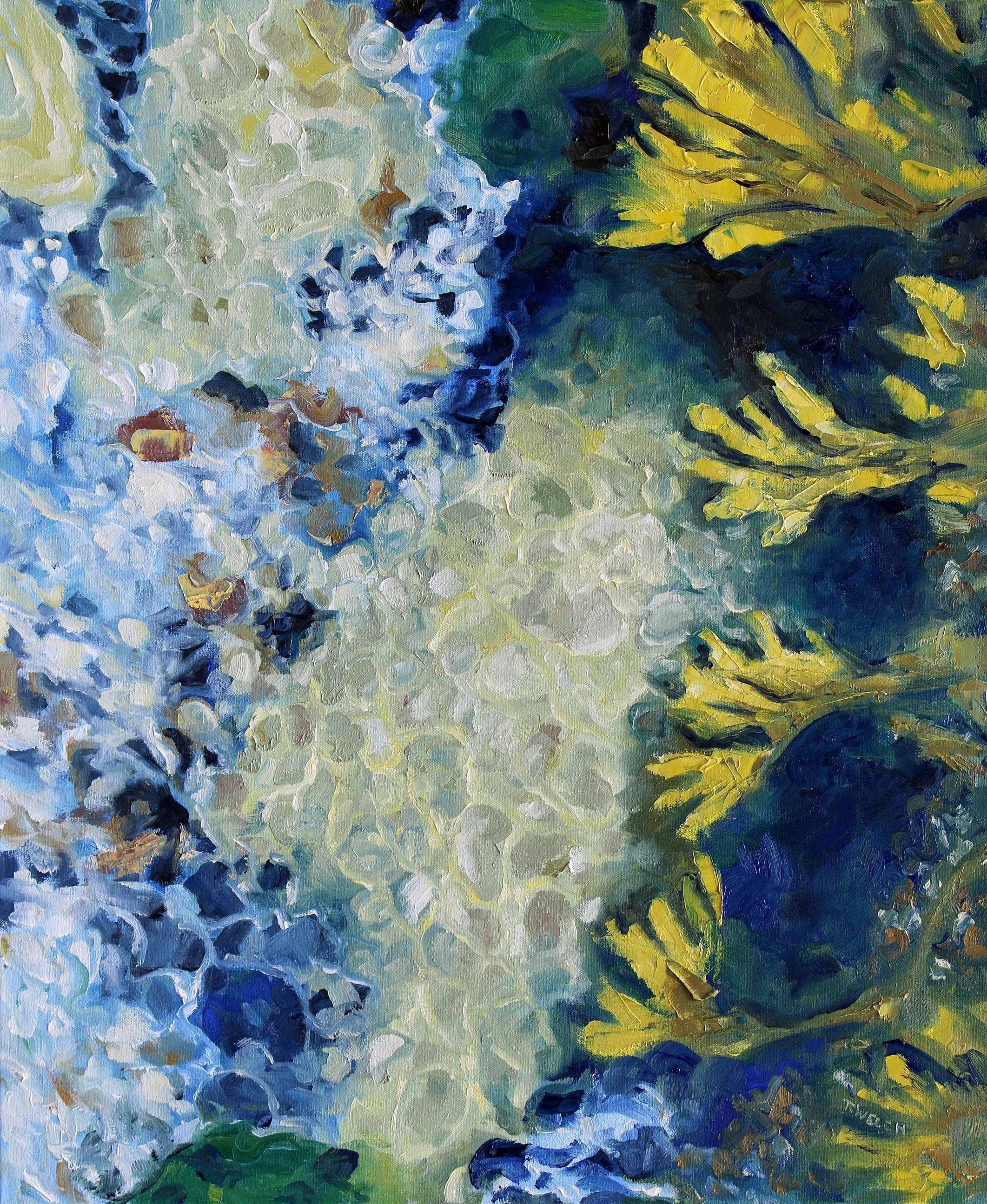
Terrill Welch
The Long Goodbye
Walnut Oil on Canvas 24” x 20”
CAD 4,620
The title ‘The Long Goodbye’ is frequently used in reference to living with someone who has dementia and experiencing how they slowly lose their ability to think, communicate and control their bodily functions. The loss is relentless in its grief and continuity, frequently taking years to complete its cycle towards death.
This painting is about a similar process in relationship to our planet as it slowly loses its ability to support human and animal life. The data and our own experiences record the physical changes. It is then up to each of us to find our emotional path while knowing we may not have the capacity to come to terms with what is before us.
In my figurative and abstract rendering of a Salish Sea tidal pool, I have asked myself to brush, push, slide and scrap my way forward while letting go of any specific outcome, both for the canvas and for living in these beautiful broken moments. - T. Welch
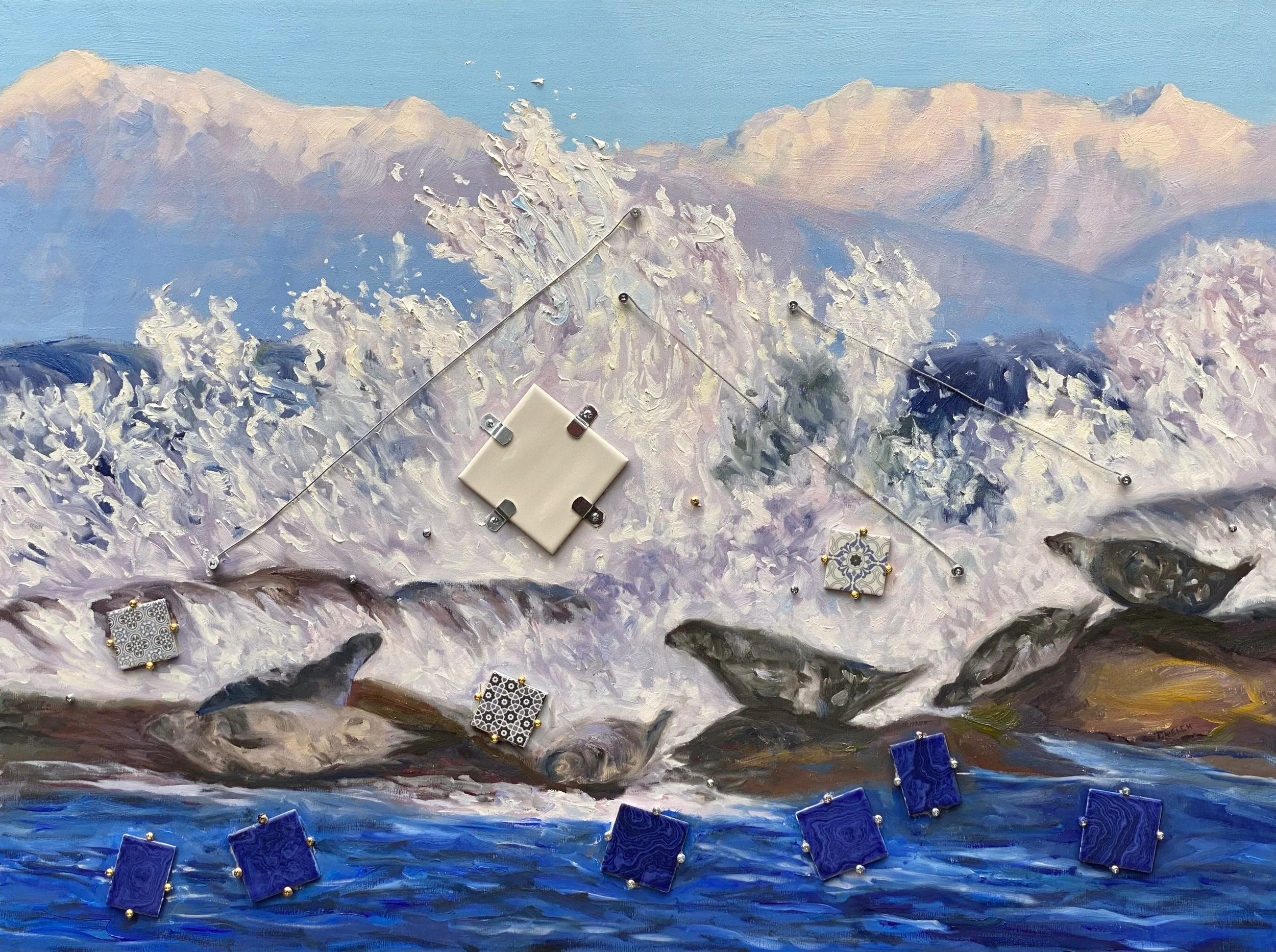
Terrill Welch
Sea and Seals
Oil, ceramic tiles, screws and wire on wood 30” x 40”
CAD 10,000
It was so cold that ice was about two inches thick on the sandstone and the sea spray was freezing like mist as it was blown across rolling waves. Yet, the seals rested in their usual place.
The paint brush marks are the impressions of nature and the screws, wire and tiles are the intervention by our human species.
This work will always interact in noticeable ways with its immediate physical environment through the light, reflections and shadows of the materials. In this way, the painting remains a work-in-progress forever. - T. Welch
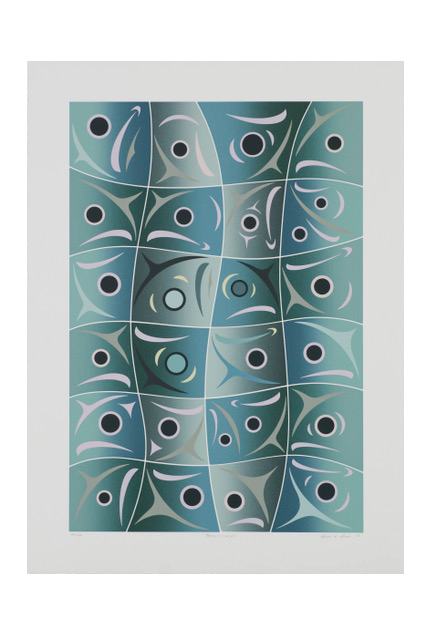
Susan Point
Broken Circle
Serigraph, Edition of 52
CAD 1,780 (framed)
With its fishing net bulging under the weight of a large catch of fish, Broken Circle is a piece that talks about the dangers facing fish species around the world, and in particular on the West Coast of North America where the Musqueam people, and Susan’s own sons, fish. Factors such as Global Warming, and over fishing among others, have brought the number of salmons returning each year to spawn to an all time low.
Throughout the cycle of the salmon from their spawning ground where many water levels are low and temperatures are too warm for small fry, through the rivers and the ocean where they face other perils for the rest of their lives, there are a host of conditions working against these majestic fish.
The fine details of Broken Circle compel the viewer to draw closer, and take a careful look at what is happening in the image. Susan’s hope is that it will also inspire people to look closer in order to understand the subtleties and multitude of factors involved in the issue of dwindling fish stocks.
By looking closer and seeking to understand the problem, perhaps we can all take small, positive steps to take better care of the earth and its creatures.
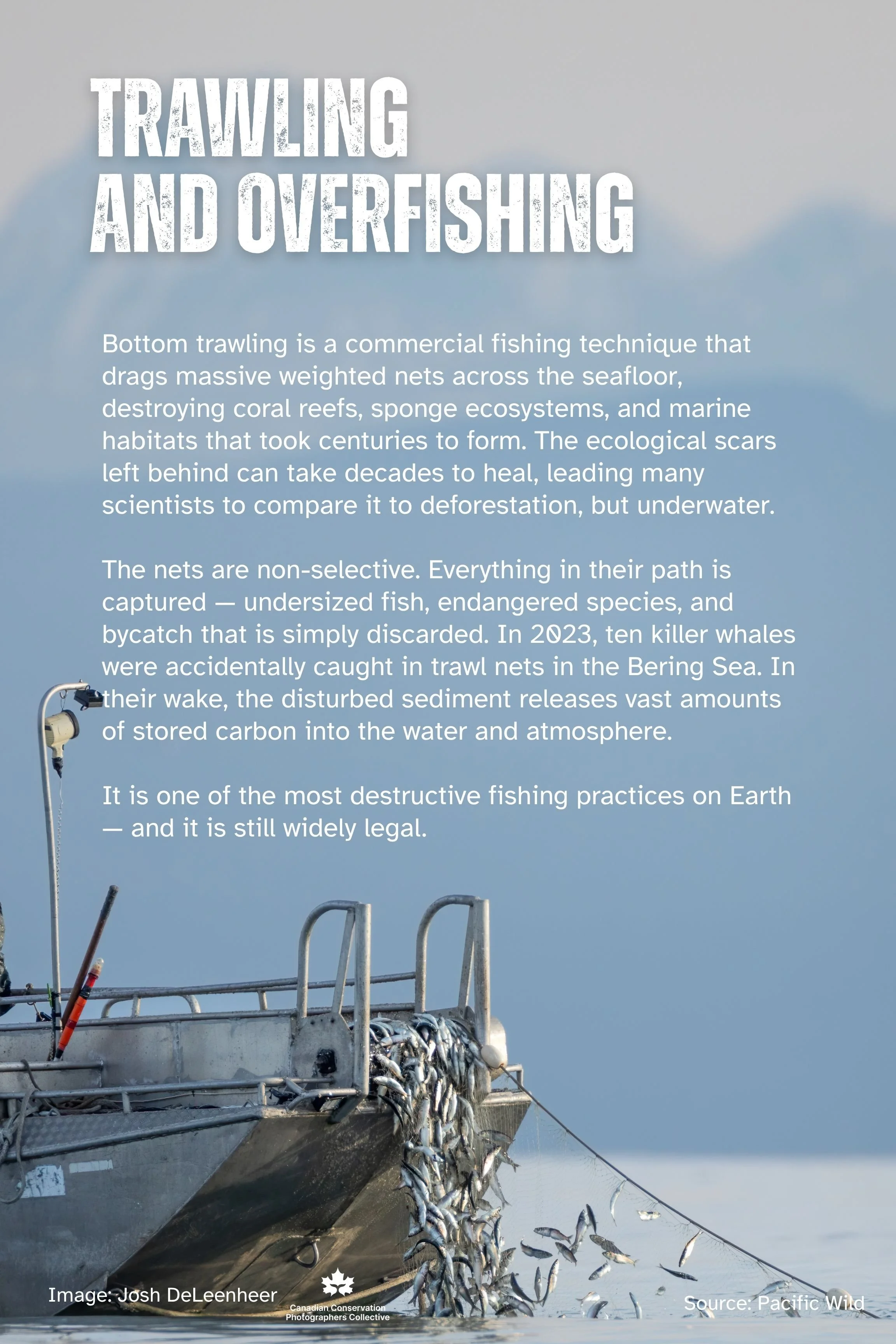
StorytellART x Josh DeLeenheer, CCPC
Trawling and Overfishing
NFS
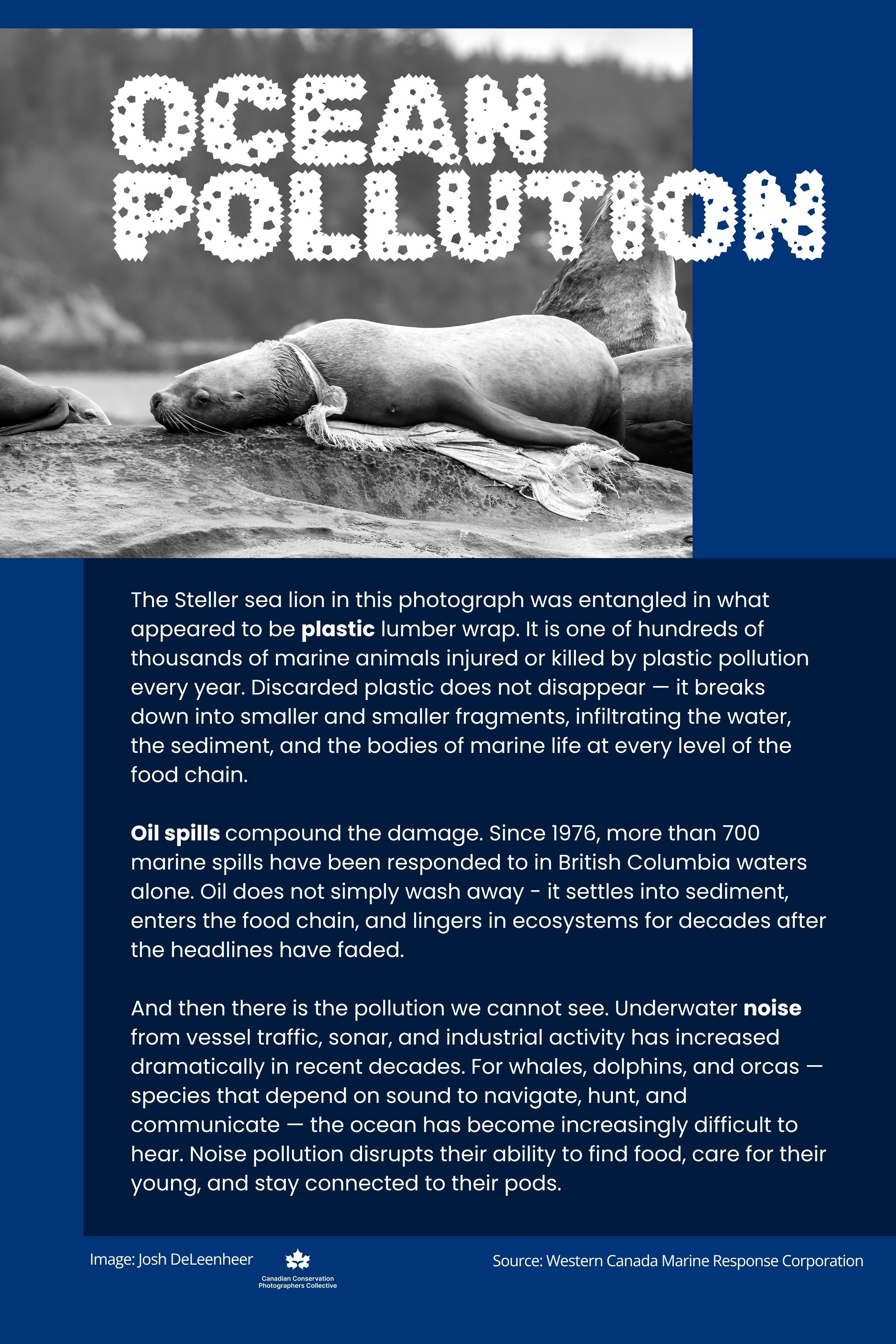
StorytellART x Josh DeLeenheer, CCPC
Ocean Pollution
NFS
CHAPTER 5: THE TURN
This is where the tide changes.
All over the world, people are choosing differently. Marine protected areas are being established — and inside them, life is returning with remarkable speed. Scientists are cultivating coral, rewilding kelp forests, and tracking the recovery of whale populations that were nearly lost. Artists, educators, policymakers, and everyday people are raising their voices and redirecting their choices.
The turn is already underway. What it needs is more of us. This is where you, standing in this gallery, become part of the story. This is our chance to give something back.
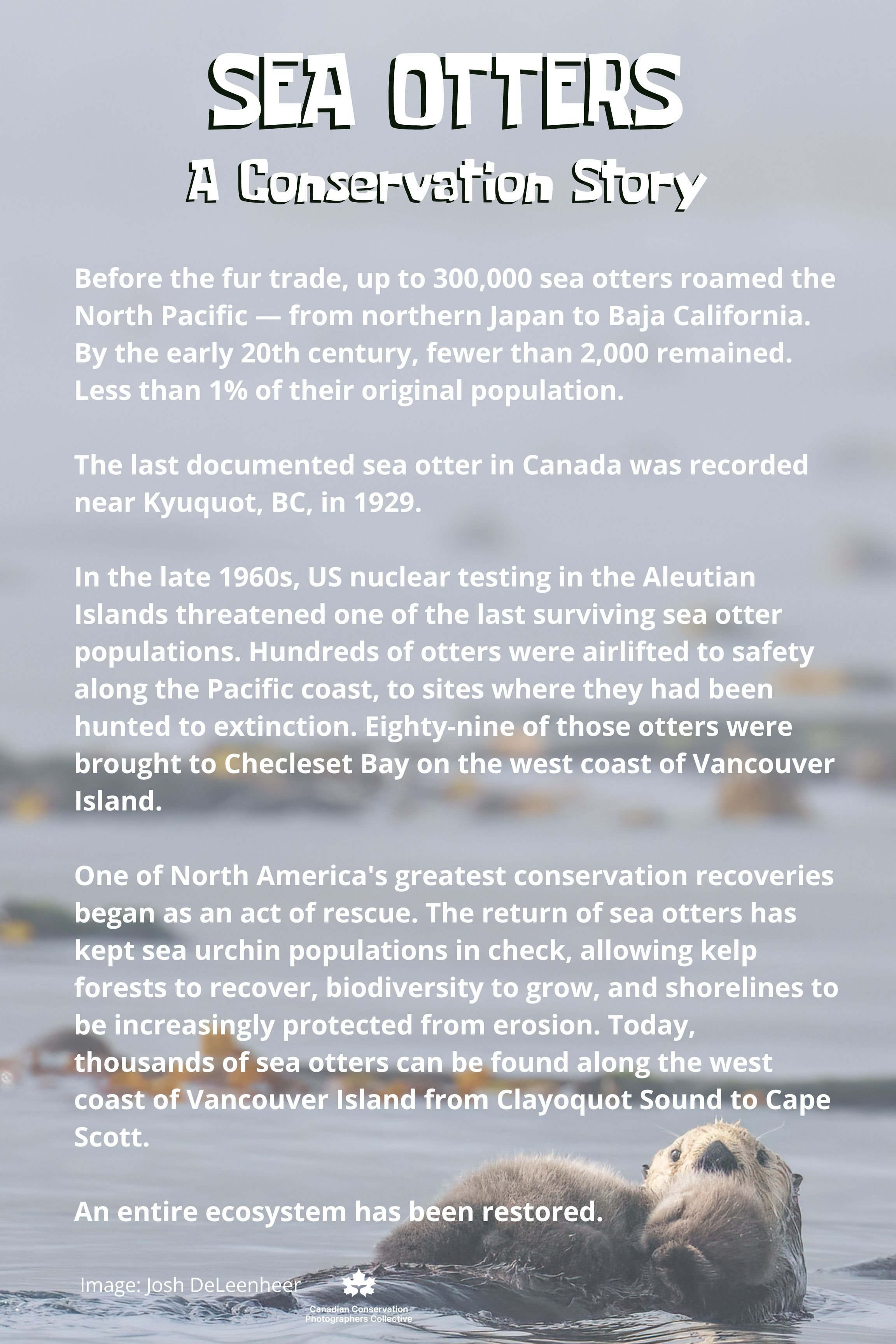
StorytellART x Josh DeLeenheer, CCPC
Sea Otters, A Conservation Story
NFS
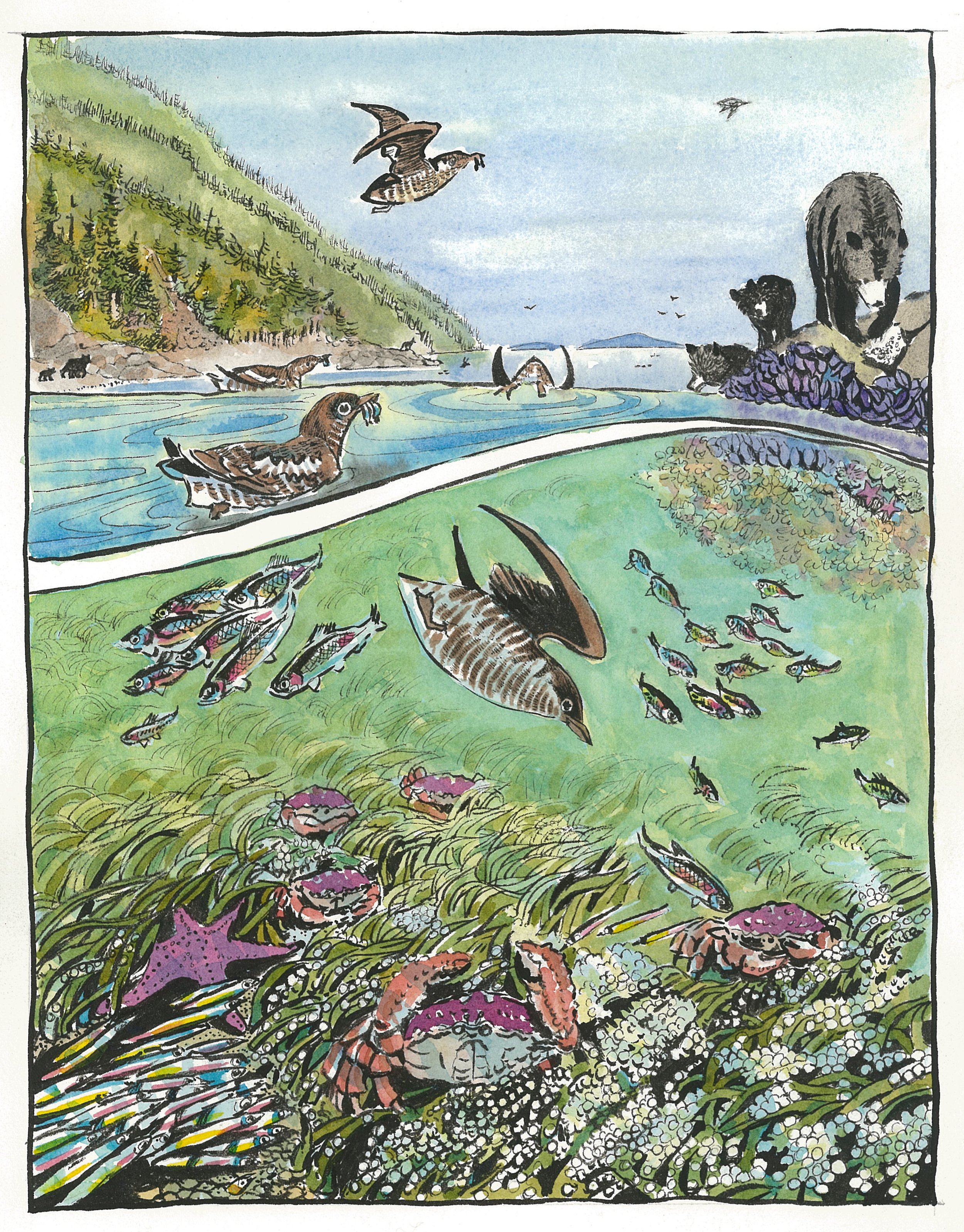
Briony Penn
Coastal Inshore
Illustration Print
CAD 75
This is an illustration of a healthy northern coastal ecosystem. It shows cultural keystone species , i.e., the species that are used as seasonal indicators of health by coastal knowledge keepers - from crabs’ eggs in the eelgrass to the marbled murrelet breeding pairs with herring in their beaks indicating a successful nest and chick.
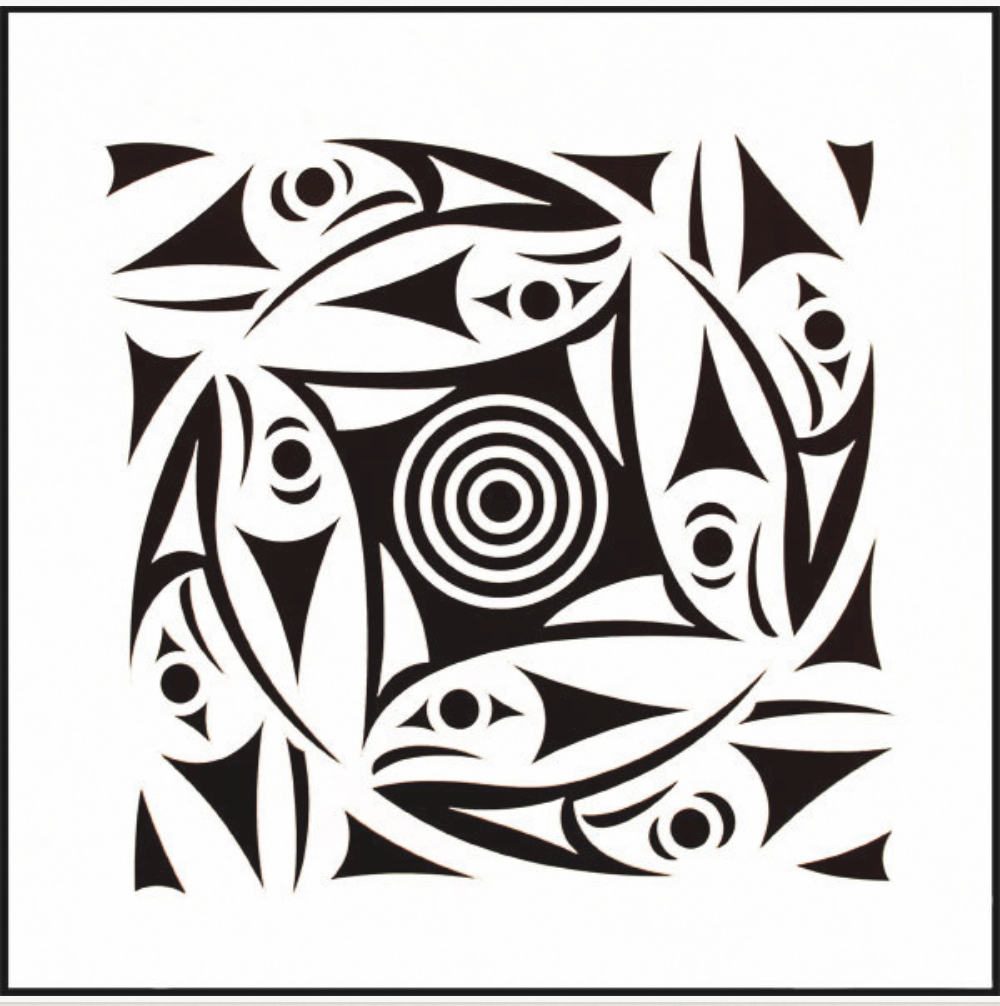
Susan Point
Circle of Life
Serigraph, Edition of 72
CAD 1,120
In Circle of Life, Susan Point expands on two favourite themes - salmon and the cycle of life. Many of her previous pieces have featured this motif of salmon swimming in a circular fashion, a metaphor for the circular nature of the cycle of life. The number four, shown here in the two sets of four salmon, is also a recurring theme in Susan’s work.
The number four carries a great deal of significance in First Nations and other cultures. There are four seasons, four winds, four directions, etc. For a salmon, the life cycle is also measured in four parts. The eggs are hatched in creeks and rivers far from the ocean. The young fry make a perilous journey to the ocean where they live until they make the long and dangerous journey back to the very place where they began their lives. It is there they lay their eggs and die. And so the cycle starts again.
In Circle of Life, Susan Point expands on this understanding with an outer set of four salmon circling around the inside four. They are all connected and what happens to one set, will eventually affect all the others. The raindrop in the centre of the image is a reminder of the importance of water - the essence of life. The ripples, spreading away from the raindrop, remind us all that all things are connected and everything we do makes a lasting impression in places we may not be able to see.
EPILOGUE
We hope you are feeling inspired, and perhaps wondering what role you might play in the story of the ocean.
Do not underestimate the power of individual action. Billions of small choices, made by people who care, can reshape the world. This exhibition was not meant to be a comprehensive account of the state of our oceans — it is a small, intentional window into what is at stake, with a focus on the Pacific Northwest and the waters we call home.
If you would like to go deeper, we encourage you to watch David Attenborough's documentary Ocean — it offers the broader view this evening could only gesture toward. Support and volunteer with the many organizations doing vital work on Vancouver Island. Pay attention to public policy, and ask your representatives what they are doing to protect our oceans. The work of Georgia Strait Alliance is a powerful place to start.
Advances in science and technology are opening remarkable new possibilities for ocean recovery. But no conservation effort in this region will be complete without the meaningful involvement of First Nations peoples, who have been stewards of these waters since time immemorial. We would do well to listen.
Keep your eyes on the horizon. The sailing will not always be smooth — but it will be worth it.
Carolina Nakiri
StorytellART Curator
If you are interested in purchasing any of the artworks or would like further information,
please contact us by clicking on the button below.